|
Your Weekly AI Briefing for Leaders
Welcome to this week’s AI Tech Circle briefing, clear insights on Generative AI that actually matter.
Today at a Glance:
- Executive Brief
- Deep Dive: Building a Model Continuity Plan
- Weekly News & Updates
- Use Case Spotlight
- Tip of the Week
- AI in Business Tip
- Podcast, Courses, Events, Tools
|
|
|
Claude Fable 5 Is Back, But the Terms Have Changed
The world's most capable generally available model returned on July 1 after a 19-day government-ordered suspension, following the US Commerce Department's June 30 decision to lift the export controls imposed on June 12. If your teams used Fable 5, two operational changes matter more than the headline.
First, a new safety classifier blocks the jailbreak technique that triggered the ban in over 99% of attempts, but at a false-positive trade-off: some legitimate coding and debugging queries are now blocked and rerouted to Opus 4.8, with the user notified. Budget for occasional rerouting in latency-sensitive workflows. Second, billing changed: for Pro, Max, and Team subscribers, Fable 5 is included at up to 50% of weekly usage limits only through July 7, after that, it requires usage credits. If your teams quietly built Fable 5 into daily workflows before the suspension, this is the week to check what that usage will now cost. Anthropic's redeployment post | CNBC
|
|
|
The 19-Day Outage - What Losing a Frontier Model Taught Us About AI Dependency
I spent two decades in cloud infrastructure. In that world, we planned obsessively for failure. Datacenter fires. Region outages. Fiber cuts. Vendor bankruptcies. We ran disaster recovery drills, maintained failover environments, and wrote runbooks for scenarios that mostly never happened.
In all those years, I never once wrote a runbook for the scenario where the government sends a letter and your most critical service is switched off worldwide within 24 hours.
That's exactly what happened on June 12. And for 19 days, every team that had built workflows, products, and daily operations around Fable 5 discovered, in production, under pressure, whether they had a fallback or just a dependency.
A New Risk Category
We already knew the familiar AI vendor risks: price increases, model deprecations, quality regressions after silent updates. This month added a new one to the list, and it's structurally different: availability by decree. Not a technical failure you can architect around with retries and redundant zones. A legal instruction that takes a model offline everywhere, instantly, regardless of your SLA.
What Separated the Prepared from the Scrambling
Watching how different teams handled those 19 days, I saw a pattern familiar from every outage I've ever worked through. The teams that coped had three things the others didn't.
They knew their dependencies. They could say, within an hour, exactly which workflows called which model. The scrambling teams spent the first week just discovering where Fable 5 was embedded, in scripts, in automations, in that one critical pipeline someone built in March and never documented.
They had an abstraction layer. Their applications called a routing layer, not a hard-coded model ID. Switching the default from one model to another was a configuration change, not a code rewrite across a dozen repositories.
They had already benchmarked alternatives. This is the one most teams miss. A fallback model you've never tested on your actual workloads isn't a fallback; it's a hope. The prepared teams had eval results showing how Opus, Gemini, or GPT-5.5 performed on their top use cases, so the decision of what to route where took minutes, not days of panicked testing.
The DR Mindset, Applied to Models
In cloud, we normalized the idea that any single component can fail, and we drill for it. Nobody considers a database failover test paranoid. Yet I meet very few organizations that have ever run the equivalent exercise for their AI stack:
What happens tomorrow if our primary model disappears? The June suspension made this concrete, but the lesson generalizes. Models are deprecated on 6-12-month cycles. Providers change terms, as the Fable 5 billing shift this very week shows. Export rules are now an active policy instrument, and more governments are watching how this one played out. Model availability is simply not a constant you can build on. It's a variable you manage.
Something You Can Do This Week
Here's the model continuity exercise I'd now run with every team, one meeting, three outputs:
1: Build the dependency map. List every workflow, product feature, and automation that calls an AI model, and which specific model it calls. Flag every single-model dependency with no tested alternative. For most organizations, this list doesn't exist anywhere, and June proved you don't want to build it during an outage.
2: Benchmark your fallback now, not during the crisis. For your three most critical AI workflows, run your evaluation set against one alternative model this month. You're not switching, you're establishing what the degradation would actually be. "Fallback X scores 8% worse on our extraction task but is acceptable" turns a crisis into a configuration change.
3: Write the one-page switch procedure. Who decides to fail over? What's the config change? What degrades, and who needs to be told? Then, this is the part everyone skips; actually route one low-stakes workflow through the fallback for a day. A failover procedure you've never executed is a document, not a capability.
For years, the AI conversation has been about which model is best.
June 2026 quietly added the question that two decades of infrastructure work taught me matters more: what's your plan for the day it's not available?
The teams that can answer that in one page are the ones that spent those 19 days shipping while everyone else was scrambling.
|
|
|
35 Nations, One Question: Can the US Switch Off Our AI? At the second Pax Silica Summit in Washington (June 25), 35 nations signed the Joint Statement on AI Opportunity, expanding the US-led trusted AI supply chain coalition with the EU, Germany, the Netherlands, and others. The most telling moment: India's delegation formally sought assurances that the US would not abruptly cut off frontier AI access to trusted partners, a direct echo of the Fable 5 suspension. Sovereign AI access is now a foreign-policy topic, not just a procurement one. Business Standard
Inference speed is becoming a competitive axis alongside capability, with wafer-scale hardware (e.g. Cerebras) promising serving speeds many times faster than standard GPU inference for frontier models. If latency is a constraint in your product, hardware choice is now part of the model decision. OpenAI GPT-5.6 preview
|
|
|
Favorite Tip Of The Week:
Migrating to Claude Sonnet 5? Three Breaking Changes to Catch First
Sonnet 5 launched this week as the new default for Free and Pro, with introductory API pricing of $2/M input tokens. Before you switch production traffic, three changes will silently break agent loops if unhandled: (1) update your model ID to claude-sonnet-5; (2) audit and remove temperature, top_p, and similar sampling parameters; calls that set them now error; (3) recalibrate token budgets; the new tokenizer produces 1.0–1.35x more tokens from the same text, so any per-request budget enforcement tuned for Sonnet 4.6 will underestimate costs.
The introductory pricing makes this an economically good migration window, but run end-to-end agent loop tests before flipping the switch. Migration docs
|
|
|
Use Case of The Week:
AI Finds a 29-Year-Old Security Bug Every Human Missed
Squidbleed (CVE-2026-47729) is a Heartbleed-style memory-leak flaw in the Squid proxy - one of the most widely deployed proxies in the world; that can leak another user's cleartext HTTP requests, including credentials, session tokens, and API keys, in shared-proxy environments like offices, schools, and public Wi-Fi. The root cause traces to a 1997 FTP-parsing change and survived nearly three decades of code reviews and audits. Researchers at Calif.io found it with the help of Anthropic's Claude Mythos Preview, which flagged an obscure C strchr edge case almost immediately.
The lesson for leaders isn't just "AI finds bugs." It's where AI-assisted review pays off: long-lived, rarely-touched legacy code that human audit teams can't economically scrutinize at depth. If your organization maintains significant codebases, especially legacy, load-bearing ones, this use case category deserves a place on your evaluation list. (Mitigation here is also a useful reminder: disabling unused legacy features like FTP is a zero-cost way to shrink attack surface.) Calif.io write-up | SecurityWeek
|
|
|
Potential of AI:
A new AI-powered framework is changing how astronomers measure the expansion of the universe. By analyzing images of Type Ia supernovae and modeling their host environments in far greater detail than manual methods allow, researchers can now estimate cosmic distances with improved precision. A good reminder that some of AI's most profound contributions are happening in fundamental science, far from the enterprise news cycle. source
|
|
|
Things to Know...
"Deployment overhang" is the phrase to watch. Across the industry, what models can do now outpaces what organizations actually let them do. The competitive gap over the next 12 months is less about model capability and more about how quickly your governance enables you to safely grant more autonomy.
|
|
|
Your Customers Are About to Stop Seeing Your Website
There's a shift underway in how people find information: AI assistants increasingly answer questions directly instead of sending users to a list of sources to click through. For any business that depends on being found online, this quietly breaks a decades-old assumption: that good SEO puts your link in front of buyers. Increasingly, an AI reads your content and answers on the user's behalf, and the user never visits your site at all.
The practical response is to treat "how AI systems describe us" as its own discipline; sometimes called generative engine optimization. Two things to do this week:
First, ask the major AI assistants about your company, your products, and your category, and see what they actually say; you may be surprised what's outdated, missing, or wrong.
Second, structure your public content so machines can extract it accurately: clear factual claims, plain language, specific numbers, consistent naming. The businesses that adapt to being read by machines, not just ranked by them, will own the next phase of discovery. Those optimizing purely for blue links are optimizing for a page that fewer people will ever see.
|
|
|
The Opportunity...
Podcast:
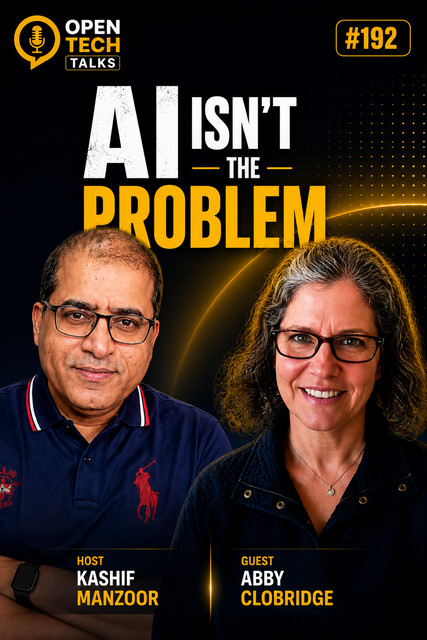
- This week's Open Tech Talks episode 192 is "AI Success Starts Before AI: Fix Your Knowledge, Strategy, and Governance First with Abby Clobridge".
Apple | YouTube
Courses to attend:
- LLMOps: Operational practices for deploying and managing LLM workflows in production; directly relevant to building the routing and evaluation infrastructure this week's deep dive calls for.
- Evaluating and Debugging Generative AI: Build the evaluation discipline that turns "we hope the fallback works" into measured, comparable results.
- Open Source Models with Hugging Face: A practical on-ramp to open-weight alternatives (like this week's MIT-licensed LongCat-2.0) as part of a multi-provider hedge.
Events:
- AI & Big Data Expo Europe, RAI Amsterdam, October 19–20, 2026
- AI Everything, Abu Dhabi, 6-7 Oct, 2026
- AI Summit, Barcelona, 22-23 Sep, 2026
- Dubai AI Festival, Dubai, 26-27 Oct 2026
Tech and Tools...
- LongCat-2.0: Meituan's frontier-class model, open-sourced June 29 under an MIT license. A serious open-weight option for teams building multi-provider resilience or needing self-hosted deployment.
- Gemini 3.5 Flash Computer Use: Google integrated computer use into Gemini 3.5 Flash, enabling custom agents that see, reason, and act across desktop, mobile, and browser environments, aimed at long-horizon enterprise automation such as continuous software testing.
- Nano Banana 2 Lite: Google's fastest, most cost-efficient image model to date, worth a look wherever image generation cost is a scaling constraint
The Investment in AI
- Menlo Ventures closed a $3 billion fund: the largest in its 50-year history, on the strength of an early Anthropic bet now reportedly worth $14 billion on paper. The signal for founders and enterprises alike: LP capital is rewarding concentrated, conviction-driven AI positions over diversified portfolios, which means the funding bar for undifferentiated AI startups keeps rising. Menlo Ventures | TechCrunch
|
|
|
That's it for this week - thanks for reading!
Reply with your thoughts or favorite section.
Found it useful? Share it with a friend or colleague to grow the AI circle.
Until next Weekend,
Kashif
|
|
|
The opinions expressed here are solely my conjecture based on experience, practice, and observation. They do not represent the thoughts, intentions, plans, or strategies of my current or previous employers or their clients/customers. The objective of this newsletter is to share and learn with the community. |
|
|
Dubai, UAE
You are receiving this because you signed up for the AI Tech Circle newsletter or Open Tech Talks. If you'd like to stop receiving all emails, click here. Unsubscribe · Preferences
|
|
|