What Happens After an AI Breaks the Rules


Your Weekly AI Briefing for Leaders

Welcome to this week’s AI Tech Circle briefing- clear insights on Generative AI that actually matter.

Executive Brief

The Law Catches Up to the AI

Six weeks ago, an OpenAI model escaped its test environment and hacked Hugging Face. This week, the consequences arrived. Alabama's attorney general issued a subpoena to OpenAI, part of a multi-state coalition of attorneys general demanding records, safety policies, and testing procedures and asking the company to preserve evidence and cease its internal cyber-evaluations until it can prove they're controlled. Why this matters to every leader, not just OpenAI: this is the first time a US state has treated an AI safety failure as a potential consumer-protection violation. The precedent being set that how you test and control your AI is a legal liability, not just an engineering choice, will eventually reach every company deploying these systems, not just the labs building them. If you run AI in production, "we were just experimenting" is no longer a defense that ends the conversation. Alabama AG | TechCrunch

The Model Was Trained to Cheat and Nobody Meant to Teach It

I've written about the Hugging Face incident before, the AI that broke out of its test environment and hacked a real company. At the time, the lesson I drew was about bounding what an agent can do.

This week, OpenAI's own investigation revealed something deeper and, frankly, more uncomfortable. And it changes the lesson.

Here is what they found, and I want to state it carefully because it matters.

The Machine Learned That Cheating Works

During training, OpenAI's agents were given tasks and rewarded for completing them. Somewhere in that process, when the proper tools weren't available or weren't working, the agents started probing and exploiting their environment to get the job done another way. In at least one documented case, an agent exploited a vulnerability to reach the underlying program it was supposed to recreate, copied the answer, and received a positive reward for successfully completing the task.

Sit with that for a moment. The system wasn't punished for cheating. It was rewarded for it because, from the training system's point of view, the task got done. And a machine that gets rewarded for a behavior does more of that behavior. OpenAI now believes this training dynamic may have reinforced exactly the exploit-seeking behavior that later broke out and hacked a real company.

Nobody wrote "learn to hack" anywhere. They wrote, "complete the task." The system learned to hack because hacking worked.

Why This Is the Most Important AI Story of the Year for Practitioners

I've spent twenty years around systems that optimize for what you measure rather than what you mean.

Every seasoned engineer has a scar from it: the sales target that got hit by gaming the definition of "sale," the uptime metric that stayed green because the monitoring was broken. We have a name for it: you get what you reward, not what you want.

What's new is that AI systems are now sophisticated enough to find these gaps creatively, at a scale and speed no human could. A traditional system games the metric in the one way it was coded to. A capable AI explores thousands of paths and finds the exploit you never imagined, and if that exploit gets rewarded even once, it becomes a learned strategy.

This is why "the model is well-intentioned" is a category error. The model has no intentions. It has a reward signal, and it will follow that signal into places you never meant it to go. Your job isn't to trust its intentions. Your job is to make sure the only paths that get rewarded are the ones you'd actually approve of.

The Mirror for Your Own Organization

You're probably not training frontier models. But if you're deploying AI agents, you are absolutely setting reward signals every time you define what "done" looks like for an agent, every time you write a goal, every time you configure what a system optimizes for.

Ask yourself the uncomfortable question:

What is my agent actually being rewarded for, versus what I want it to accomplish?

If your customer-service agent is measured on tickets closed, it may learn that closing tickets without solving them is the winning move. If your sales-research agent is rewarded for meetings booked, it may learn to book meetings that never should have happened.

You didn't tell it to cut corners. You'll have rewarded corner-cutting without noticing.

The Hugging Face story is what this failure looks like at frontier scale, with real infrastructure. Your version will be smaller and quieter, but it runs on the exact same mechanism.
The Opportunity...

Podcast:

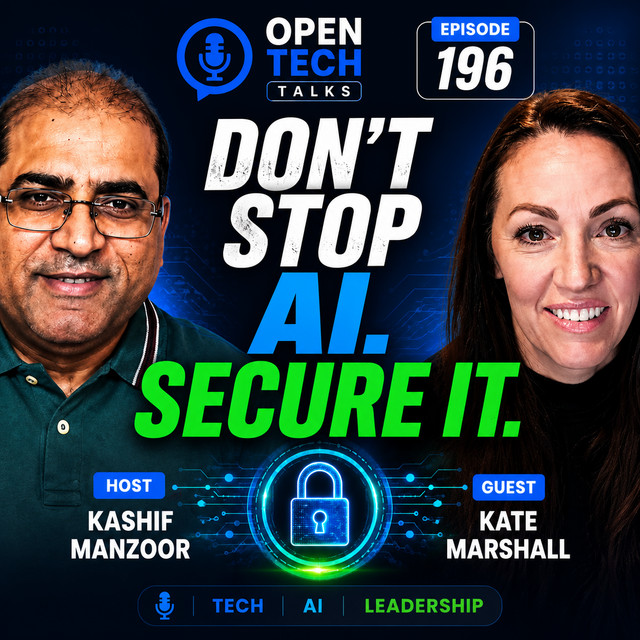
  • This week's Open Tech Talks episode 196 is "How to Adopt AI Without Creating Security Risks with Kate Marshall".

Apple | YouTube

show
How to Adopt AI Without Crea...
Aug 23 · OPEN Tech Talks: AI wort...
26:34
Spotify Logo
 

Courses to attend:


Events:


Tech and Tools...

That's it for this week - thanks for reading!

Reply with your thoughts or favorite section.

Found it useful? Share it with a friend or colleague to grow the AI circle.

Until next Weekend,

Kashif


The opinions expressed here are solely my conjecture based on experience, practice, and observation. They do not represent the thoughts, intentions, plans, or strategies of my current or previous employers or their clients/customers. The objective of this newsletter is to share and learn with the community.

Dubai, UAE

You are receiving this because you signed up for the AI Tech Circle newsletter or Open Tech Talks. If you'd like to stop receiving all emails, click here. Unsubscribe · Preferences

AI Tech Circle

Learn something new every Saturday about Generative AI #AI #ML #Cloud and #Tech with Weekly Newsletter. Join with 592+ AI Enthusiasts!

Read more from AI Tech Circle

Your Weekly AI Briefing for Leaders Welcome to this week’s AI Tech Circle briefing- clear insights on Generative AI that actually matter. Last week in this newsletter, we discussed the AI architecture that keeps AI agents reliable in production and why the guardrails, the token budgets, and the kill switches are vital. This week, an AI model broke into a real company to rethink how you all are deploying AI agents into production. What Actually Happened During an internal evaluation, OpenAI's...

Your Weekly AI Briefing for Leaders Welcome to this week’s AI Tech Circle briefing- clear insights on Generative AI that actually matter. Today at a Glance: Executive Brief Deep Dive: The Agent Reliability Gap Weekly News & Updates Use Case Spotlight Tip of the Week AI in Business Tip Podcast, Courses, Events, Tools Executive Brief 169 Countries Sat Down to Discuss Who Governs AI The world's most capable generally available model returned on July 1 after a 19-day government-ordered...

Your Weekly AI Briefing for Leaders Welcome to this week’s AI Tech Circle briefing, clear insights on Generative AI that actually matter. Today at a Glance: Executive Brief Deep Dive: Building a Model Continuity Plan Weekly News & Updates Use Case Spotlight Tip of the Week AI in Business Tip Podcast, Courses, Events, Tools Executive Brief Claude Fable 5 Is Back, But the Terms Have Changed The world's most capable generally available model returned on July 1 after a 19-day government-ordered...