|
Your Weekly AI Briefing for Leaders
Welcome to this week’s AI Tech Circle briefing- clear insights on Generative AI that actually matter.
I usually write this newsletter over the weekend, and I even kept it for a few weeks without writing it. I thought it was worth writing. And that's maybe procrastination; I was putting it off. And maybe the good reason is that with all the LLMs and Generative AI, all the knowledge and everything is there; whatever you want, you can type it, you just prompt and get it.
But then I asked myself why I was writing so much about this. I was sharing what I learned with community members, with you, with all of you. Your questions coming to my inbox, to my social media, or in DMs, or in conversation with me- all of that pushes me to write this one. And although I get help from Generative AI, as English is my second language, I do get support from large language models to write it down. And that's why, if you look at the bottom, there's a logo showing it's a combination of writing with LLMs and human review of the content, ideas, and thoughts behind it.
So, as the core principle when I started writing this AI tech circle two years ago, and even the name, AI technology circle, was maybe a tribe or a community, it all revolves around that one. So I'll keep pushing myself. I will keep motivating myself to keep writing, sharing whatever I can get out of the week, whatever I learned, an observation, or maybe just the news. That's why things keep changing every week. This week, there are a lot of new things.
There is a race in AI, but I feel everyone has to decide for themselves what they want to do in their career and in learning AI, because it's important to know how to execute it and how to take baby steps to do it.
And frankly, even now I'm not typing this one. I'm just talking, and you'll be surprised that I'm using Superwhisper. A Superwhisper with a local model. I'm just talking, and then it drafts and converts whatever I say, and then it is here. Then I'll use Grammarly to update it or change it to make it coherent and grammatically correct. And then we have this one.
Even typing is going away. As things stand, technology is improving every day, so you need to decide your race.
|
|
|
Executive Brief
Agentic AI is the dominant buzzword in enterprise technology, but the production reality is stark. Recent industry data shows that up to 88% of AI agents never make it to production deployment.
Furthermore, Gartner predicts that over 40% of agentic AI projects will be canceled by 2027, primarily due to operational, governance, and management failures, not a lack of model capability. The bottleneck isn’t intelligence anymore; it’s reliability.
|
|
|
Silent Killers of Agentic AI And How to Fix Them
When autonomous AI agents fail in production, they don’t just return a bad answer; they can take costly, compounding actions.
Here are the three most common operational failures and the practical fixes your team can implement this week.
The Infinite Loop Trap
AI Agents can get stuck in repetitive tool-calling cycles (e.g., searching a database, failing, and retrying the exact same query). This silently burns through token budgets, spikes API costs, and degrades system performance.
To fix, implement strict step budgets and circuit breakers. Hard-code a maximum number of tool calls per task (e.g., 3 attempts). If the agent fails to resolve the task within that limit, it must automatically yield to a human operator with a summary of what it tried.
Tool Permission Creep
To "get the job done," developers often grant agents broad, static API access to internal systems (CRMs, databases, internal wikis). This creates major security and data-leakage risks if the agent is tricked by a malicious or poorly phrased prompt.
To fix this, enforce the Principle of Least Privilege (PoLP) for agents. Avoid using static API keys. Instead, require agents to request short-lived, scoped credentials (like temporary JWTs) for every specific action, validated by a middleware gateway before execution.
The "State" Amnesia
As workflows grow beyond two or three steps, agents lose track of their own progress. Relying solely on the LLM’s context window to remember what it did three steps ago leads to redundant actions and contradictory outputs.
To fix this, externalize the agent’s memory. Use a dedicated, structured state-management layer (like a workflow orchestrator or a simple JSON state tracker) that logs completed steps, pending actions, and verified facts. The LLM should read from this state, not just its own conversational history.
|
|
|
The Opportunity...
Podcast:
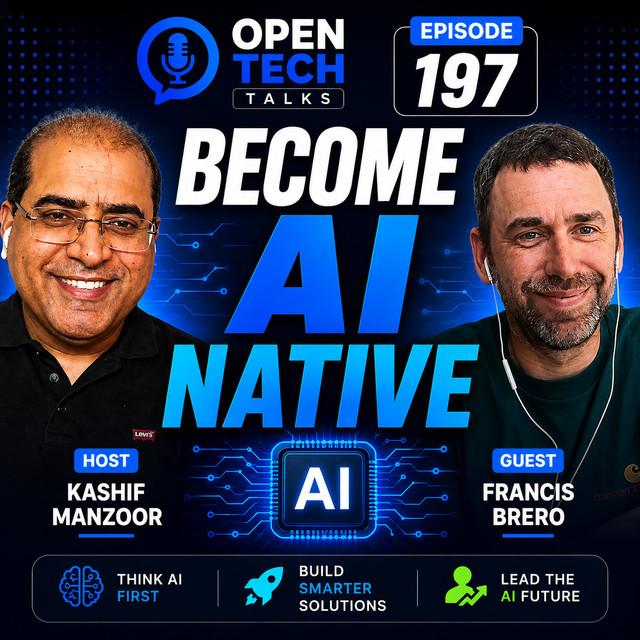
- This week's Open Tech Talks episode 197 is "Building an AI Native Enterprise with Francis Brero".
Apple | YouTube
Courses to attend:
- Introduction to On-Device AI: Directly relevant to this week's deep dive; how to deploy models on phones and edge devices, built with Qualcomm.
- Quantization in Depth: The core technique for making models small enough to run locally and a genuinely rare, in-demand skill.
- Intro to Federated Learning: How to train and improve models without centralizing sensitive data; the privacy-preserving counterpart to on-device inference.
Events:
- AI & Big Data Expo Europe, RAI Amsterdam, October 19–20, 2026
- AI Everything, Abu Dhabi, UAE, 6-7 Oct, 2026
- AI Summit, Barcelona, 22-23 Sep, 2026
- Dubai AI Festival, Dubai, UAE, 26-27 Oct 2026
Tech and Tools...
- Muse Code: Meta's dedicated coding model, released alongside its return to open weights, a self-hostable option for teams wanting a coding agent inside their own perimeter
|
|
|
That's it for this week - thanks for reading!
Reply with your thoughts or favorite section.
Found it useful? Share it with a friend or colleague to grow the AI circle.
Until next Weekend,
Kashif
|
|
|
The opinions expressed here are solely my conjecture based on experience, practice, and observation. They do not represent the thoughts, intentions, plans, or strategies of my current or previous employers or their clients/customers. The objective of this newsletter is to share and learn with the community. |
|
|
Dubai, UAE
You are receiving this because you signed up for the AI Tech Circle newsletter or Open Tech Talks. If you'd like to stop receiving all emails, click here. Unsubscribe · Preferences
|
|
|