|
Your Weekly AI Briefing for Leaders
Welcome to this week’s AI Tech Circle briefing, clear insights on Generative AI that actually matter.
Today at a Glance:
- AI Weekly Executive Brief
- The Four Enterprise AI Operating Models
- Tip of the Week
- Podcast
- Courses and events to attend
- Tool / Product Spotlight
|
|
|
Apple Rebuilds Siri and Opens the iPhone to Third-Party AI
At WWDC 2026 on June 8, reportedly Tim Cook's last keynote as CEO, Apple unveiled "Siri AI," a ground-up rebuild that handles multi-step requests, understands on-screen context, and works across apps. Two shifts matter for our space. First, the new Siri runs in part on Apple Foundation Models, built in collaboration with Google's Gemini, reportedly costing Apple around $1 billion a year. Second, and more significantly, Apple is opening iOS to multiple third-party models, letting users hand complex queries to ChatGPT, Claude, or Gemini. On the developer side, Xcode 27 now brings coding agents from Anthropic, Google, and OpenAI directly into the workflow. For a company that built its brand on in-house silicon and on-device processing, leaning on rivals' models is a real philosophical shift, and it strips any single provider of an exclusive lock on the iPhone.
The Trillion-Dollar IPO Week Arrives
SpaceX (which now includes xAI) priced its IPO this week, targeting $1.75 trillion or above, backed by Starlink's genuine operating income, while the xAI division remains a cash drain that the listing must fund. Anthropic, fresh off its June 1 confidential filing, sits on a $44 billion annualized run-rate and is on track for its first operating profit (around $559 million) in Q2 2026. OpenAI, working with Goldman Sachs and Morgan Stanley, is targeting a September listing despite a deeply negative operating margin. Three very different financial profiles heading into public markets.
Anthropic Formalizes Its $100M Partner Program
Anthropic launched the Claude Partner Hub and Services Track, structuring a $100 million investment for the system integrators, consultancies, and AI-native firms that help enterprises deploy Claude in production. The Services Track measures practice quality through certified practitioners, production deployments, and customer references — a signal that the hard part of enterprise AI is now implementation, not model access.
|
|
|
Your AI Center of Excellence Won’t Scale - Here’s the Operating Model That Will
Most enterprises building AI capabilities start the same way: by creating a Center of Excellence. A central team of AI experts who set standards, build solutions, and govern AI across the organization.
It’s the right move, at first.
But here’s what I keep seeing: the same CoE structure that launches an organization’s AI capability becomes the bottleneck that strangles it eighteen months later. The model that got you to your first ten use cases cannot get you to your next hundred.
This week, I want to walk through the four enterprise AI operating models, when each one works, when each one breaks, and the data-backed reason most enterprises eventually converge on the same answer.
Why Operating Model Beats Talent
Let me start with the insight that reframes this entire conversation:
And there’s hard data behind this. IBM research found that Chief AI Officers operating in centralized or hub-and-spoke models achieved 36% higher ROI than those in decentralized structures. That gap reflects the compounding effect of shared infrastructure, consistent governance, and institutional learning.
Meanwhile, Deloitte’s 2026 State of AI report found that governance readiness is just 30% among companies already deploying AI, compared with 43% for technical infrastructure and 40% for data management. That gap isn’t a technology gap. It’s an operating model gap. Enterprises are building the car before deciding who drives it or what happens when it takes a wrong turn.
The Four Enterprise AI Operating Models
Every enterprise AI organization is some version of one of these four models. Understanding which one you’re in, and which one you’re evolving toward, is one of the highest-leverage decisions a leader can make.
The Natural Evolution Path
Here’s the pattern I see in enterprises that successfully scale AI. They don’t pick one model and stick with it. They evolve through them as their maturity grows:
How This Connects to the GenAI Maturity Framework
Operating model maps directly to the Strategy & Leadership and Talent & Culture dimensions of the GenAI Maturity Framework. Your operating model both reflects and constrains your maturity. An organization stuck in a centralized CoE will struggle to advance past Level 3, no matter how strong its technology, because the structure itself limits how fast value can scale.
The diagnostic question: Is your operating model the one that matches where you are, or the one that matched where you were eighteen months ago?
|
|
|
- US Pushes Frontier AI into National Security: A new national security memorandum directs the accelerated adoption of frontier AI across the national security enterprise, requires an AI governance policy for 14 covered agencies within 90 days, and orders terms. source
|
|
|
Favorite Tip Of The Week:
Xcode 27 Now Has Multi-Vendor Coding Agents - Use the Right One per Task
With Apple opening Xcode 27 to coding agents from Anthropic, Google, and OpenAI, developers no longer have to pick a single AI provider. The practical move: stop defaulting to whichever model you started with. Different models have different strengths; one may handle large-context refactoring better, another may be faster for quick completions, another may be stronger at test generation.
If you lead a development team, this is the moment to run a short internal bake-off: give the same real task to each available agent and let your engineers compare. The answer to "which AI coding tool should we standardize on?" is increasingly "it depends on the task," and now the tooling finally lets you act on that.
|
|
|
Potential of AI:
JPMorgan's reclassification of AI as core infrastructure is the clearest signal yet that enterprise AI has crossed from experiment to operating cost. When the world's largest bank treats AI spending with the same non-negotiable priority as fraud detection and reports it has already self-funded through $2 billion in savings, every CFO in its competitive set feels the pressure. Expect a wave of CFO-level AI audits through Q3, separating the companies that have integrated from those that have merely purchased.
The Reclassification — analysis
|
|
|
AI in Business Tip:
Audit Where Your AI Tools Actually Live
A simple diagnostic from this week's research: if your AI tools aren't connected to a specific role, a specific process, and a specific weekly metric, you are, statistically, in the 80% of companies getting zero measurable return.
Don't confuse tool adoption with transformation. Buying licenses is procurement. Rebuilding a workflow around AI is a transformation. Only the second one shows up in your productivity numbers. Before approving your next AI tool renewal, ask the owner to specify the role, process, and metric. If they can't, you've found a budget to redirect toward something that will actually move.
|
|
|
The Opportunity...
Podcast:
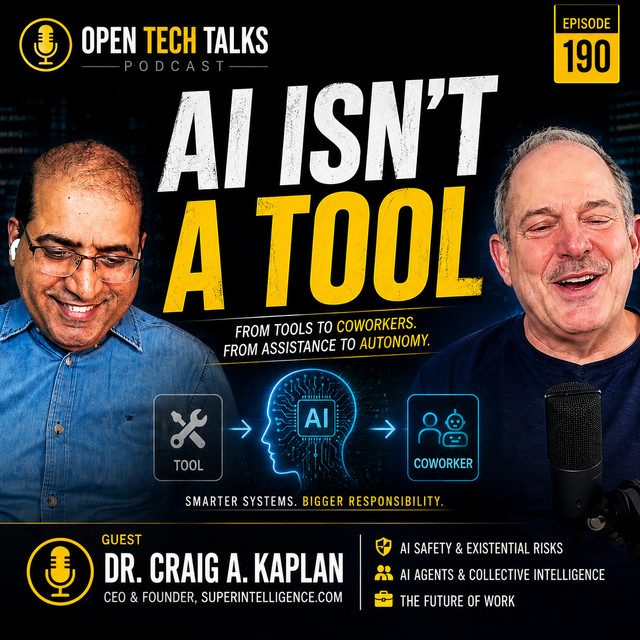
- Open Tech Talks Podcast Episode 190 "AI Safety, AGI, and the Next Decade with Dr. Craig Kaplan. He is a pioneer in artificial intelligence and the inventor behind technologies designed for safe Superintelligence. For more than four decades, he has worked at the intersection of intelligent systems, ethics, and innovation, developing architectures that help AI evolve safely and remain aligned with human values.
Apple |
Courses to attend:
Events:
- AutoScientist Challenge, June 8 – July 6, 2026 - Four-week global competition with a $50,000 prize pool; Part 1 (Jun 8-22) covers finance, healthcare, math/code, legal, and marketing.
- World AI Expo Dubai 2026 - 1,200+ AI leaders, 500+ entrepreneurs, 100+ investors from 20 countries.
Tech and Tools...
- Siri AI (iOS 27): Apple's rebuilt assistant, multi-step requests, on-screen context, and the ability to route complex queries to Claude, ChatGPT, or Gemini. A new distribution channel for every major AI provider.
- Xcode 27 now integrates coding agents from Anthropic, Google, and OpenAI directly into the developer workflow, multi-vendor by default.
- JPMorgan LLM Suite: A reference architecture worth studying, a secure interface layer letting 60,000+ employees use external LLMs without exposing sensitive data. The model many regulated enterprises will copy.
that The Investment in AI
- SpaceX (incl. xAI) priced its IPO this week, targeting a $1.75T+ valuation, seeking to raise more than $75 billion, funding the xAI division's heavy losses with Starlink's operating income.
- OpenAI is reportedly targeting a September 2026 IPO at a $730-850B valuation, working with Goldman Sachs and Morgan Stanley, despite a steep operating loss.
|
|
|
That's it for this week - thanks for reading!
Reply with your thoughts or favorite section.
Found it useful? Share it with a friend or colleague to grow the AI circle.
Until next Saturday,
Kashif
|
|
|
The opinions expressed here are solely my conjecture based on experience, practice, and observation. They do not represent the thoughts, intentions, plans, or strategies of my current or previous employers or their clients/customers. The objective of this newsletter is to share and learn with the community. |
|
|
Dubai, UAE
You are receiving this because you signed up for the AI Tech Circle newsletter or Open Tech Talks. If you'd like to stop receiving all emails, click here. Unsubscribe · Preferences
|
|
|